ServicesWisdom Teeth Removal
Wisdom Teeth Removal in Lake Dallas
Sore gums at the back of your mouth, pressure in your jaw, or an X-ray that shows a tooth coming in sideways. We look at exactly where each wisdom tooth sits, explain whether it needs to come out, and remove it with steady, gentle care.
When Wisdom Teeth Should Come Out, and When They Can Stay
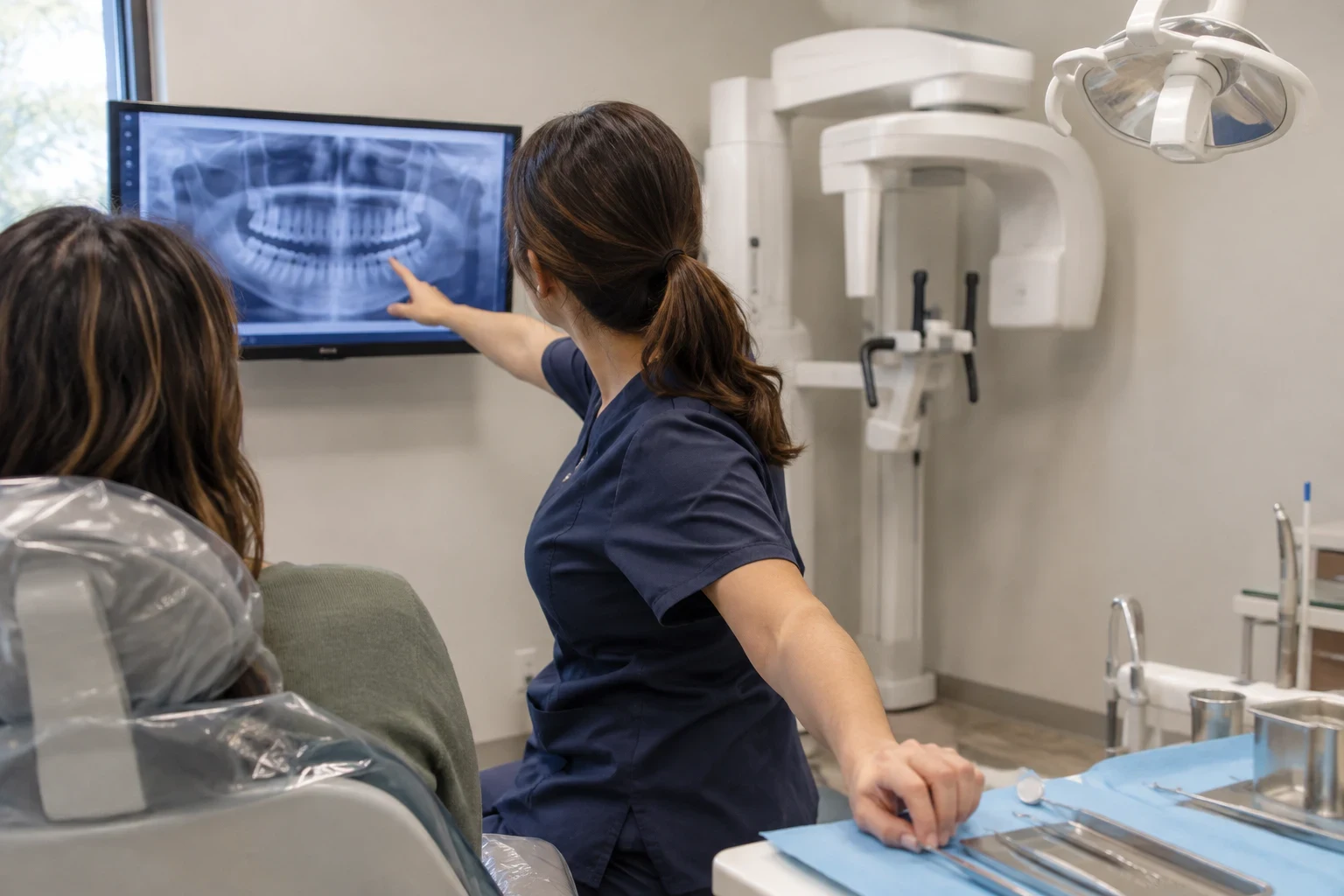
Wisdom teeth are the last molars to arrive, usually in the late teens or early twenties. Many jaws simply do not have room for them. They get stuck under the gum or bone, tilt into the tooth in front, or break through only partway and trap food where a toothbrush cannot reach.
Not every wisdom tooth has to go. If yours are fully erupted, healthy and easy to clean, we will tell you so. When removal is the right call, we plan it around one priority: keeping you safe. That means knowing where the nerve in your lower jaw runs and how close the upper roots sit to your sinus before the first instrument is picked up.
Patients come to us from Lake Dallas, Corinth, Hickory Creek and nearby towns, often after a dentist mentioned the teeth during a routine visit. A short evaluation gives you a clear answer either way.
What Your Wisdom Tooth Care Includes
- 01
Imaging before any decision
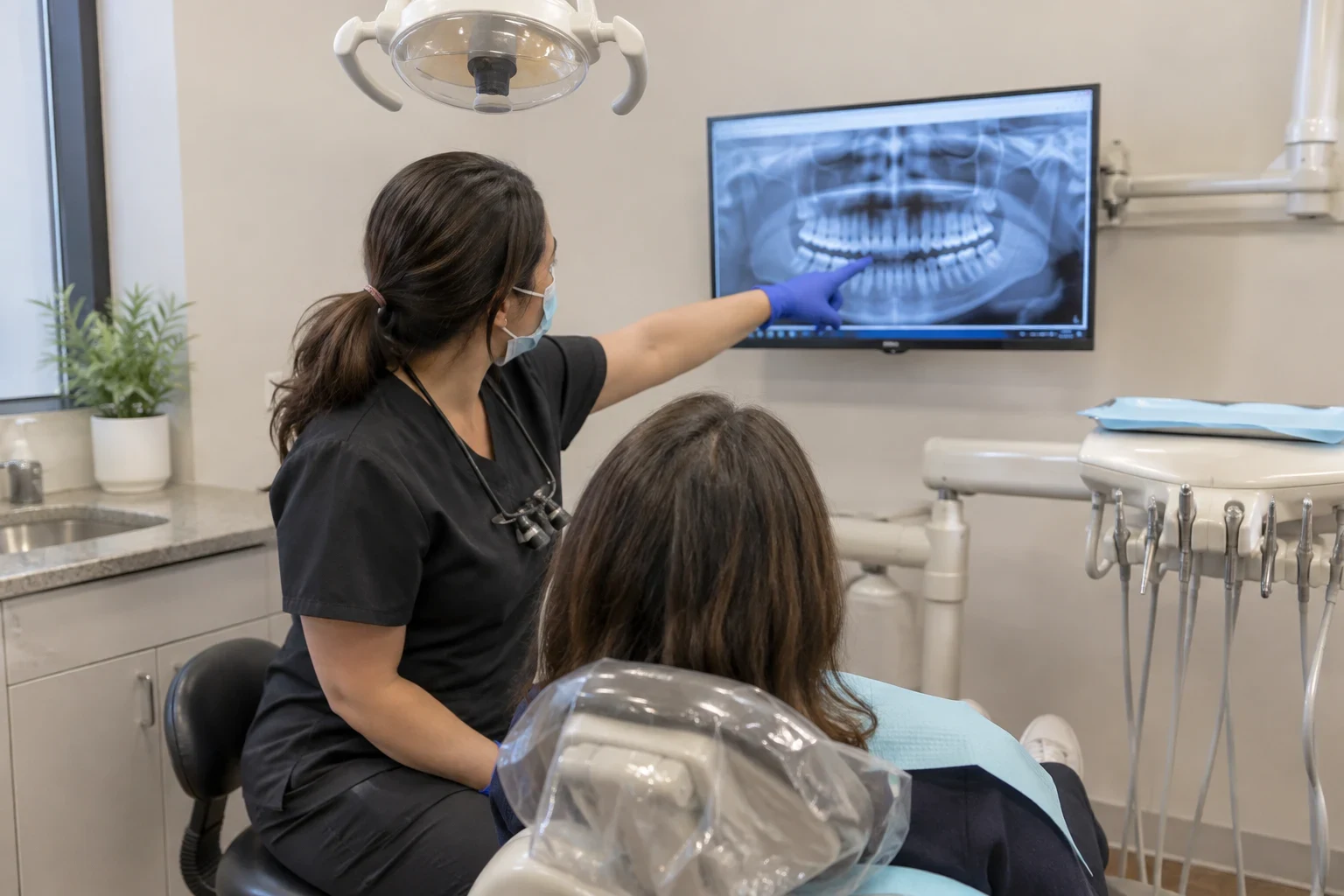
Digital X-rays show the position and angle of each tooth. When a lower tooth sits deep or close to the nerve, we add a CBCT scan, a 3D image that lets us see the roots from every side.
- 02
A full health review
We go over your medications, allergies and medical history before treatment. Blood thinners, heart conditions and recent illness all change how we plan, so we ask first.
- 03
Thorough numbing
Local anesthetic goes in first, and we check the gum and jaw carefully to confirm nothing is still sensitive before any work starts. Pressure is normal, but sharp pain is not. Raise a hand at any point and we pause.
- 04
Careful removal
Impacted teeth are often lifted out in sections, which means less force on the jaw and less disturbance to the bone around them. Sterile, single-use supplies are used for every patient.
- 05
Written aftercare and a check-in
You leave with gauze, simple written instructions and a clear idea of what normal healing feels like. We follow up to make sure the sockets are closing well.
Questions about Wisdom Teeth Removal?
Call(940) 260-3252Signs Your Wisdom Teeth Need Attention
Swollen or tender gum behind your last molar
A flap of gum over a partly erupted tooth traps bacteria. It can flare up again and again, sometimes with a bad taste or trouble opening wide.
Pressure or ache in the jaw
A tooth pushing against its neighbor often feels like a dull ache that spreads toward the ear or temple.
Crowding in your front teeth
If teeth that used to be straight start to overlap, it is worth checking what is happening at the back of the mouth.
Food that keeps getting stuck
Hard-to-clean pockets around wisdom teeth lead to cavities in the tooth and in the molar beside it.
An X-ray that shows a problem
Sometimes there are no symptoms at all. A sideways tooth or a cyst forming around a buried crown is easier to treat early, before it damages bone or nearby roots.
How Your Visit Goes
- 1
Evaluation and imaging
First comes an exam and digital X-rays. When a tooth sits deep or near the nerve, a CBCT scan gives us a 3D view of the roots. Afterward we sit down and explain what the images show, without jargon.
- 2
Your treatment plan
You get a written plan that lists which teeth need to come out, why, and the cost after insurance or membership savings. Nothing is scheduled until your questions are answered.
- 3
Removal day
We review your health history again, numb the area and confirm you are comfortable. Most patients are surprised how quickly a simple removal goes; impacted teeth take longer, and we tell you what to expect ahead of time.
- 4
Recovery at your pace
Plan on soft foods and rest for the first few days. Avoid straws and smoking so the blood clot can protect the socket, and reach us by phone if swelling or pain gets worse instead of better.
What Shapes the Cost of Wisdom Teeth Removal
Every mouth is different, so we give you the number after we have seen your X-rays, not before. Your written plan lists each tooth and each step. If you have no dental insurance, ask about our in-house membership plan. Payments can also be spread across as many as 24 months at 0% interest, and finding out whether you are preapproved will not affect your credit score.
- How deep the tooth sits
- A fully erupted tooth comes out much like any other extraction. One buried in bone needs more time and careful sectioning.
- How many teeth
- Removing two or four in one visit is usually more efficient than separate appointments, but we only recommend what you actually need.
- Imaging required
- Some cases need only standard X-rays. Teeth near the nerve or sinus call for a CBCT scan, which is included in our $25 focused evaluation if needed.
- Your dental coverage
- We are in-network with 15+ major PPO dental insurance plans and will explain what your plan is likely to cover before treatment.
Wisdom Teeth Questions We Hear Often
Will I be awake during the procedure?
Yes. We use local anesthetic to fully numb the area, so you stay awake and can tell us how you are doing at any point. Most patients feel pressure and hear some sounds but no sharp pain. We take breaks whenever you need one.
Should all four come out at once?
It depends on what the X-rays show. A healthy wisdom tooth that sits straight and is easy to brush can often stay put, even if the one beside it has to go. When several are impacted, taking them out in the same visit usually means healing just once. We walk you through the pros and cons for your own mouth.
How long does recovery take?
Most people feel noticeably better after three or four days, though the gums keep healing for a few weeks. Swelling usually peaks around day two. Cold packs, soft foods and the written instructions we give you make a real difference.
What is dry socket and how do I avoid it?
After a tooth comes out, a clot forms in the empty space and shields the bone while it heals. If that clot slips loose before its work is done, the bone underneath is left bare and sore, and that is dry socket. Skip straws, smoking and hard rinsing for the first several days. If a throbbing ache shows up a few days after removal, reach us by phone so we can see you and ease it.
Is there a right age to have them removed?
Removal tends to be easier in the late teens and twenties, when roots are shorter and bone is softer. Adults of any age can have them out safely with good planning. We see teens with a parent as well as adults who have put it off for years.
Find Out What Your Wisdom Teeth Are Doing
A focused evaluation with X-rays shows whether your wisdom teeth need to come out and how we would do it safely. New to our office? Ask about the $89 new patient special for a full exam and cleaning.